
BTM learns how each instrument has actually been moving and draws its expected range on every candle. When price moves outside it, the candle is marked, live. Same setting, same meaning on gold, the Nasdaq, and Bitcoin.
30-day free trial, then $15/month USD plus any applicable taxes — auto-renews until you cancel. Cancel anytime.
Pick up where you left off.

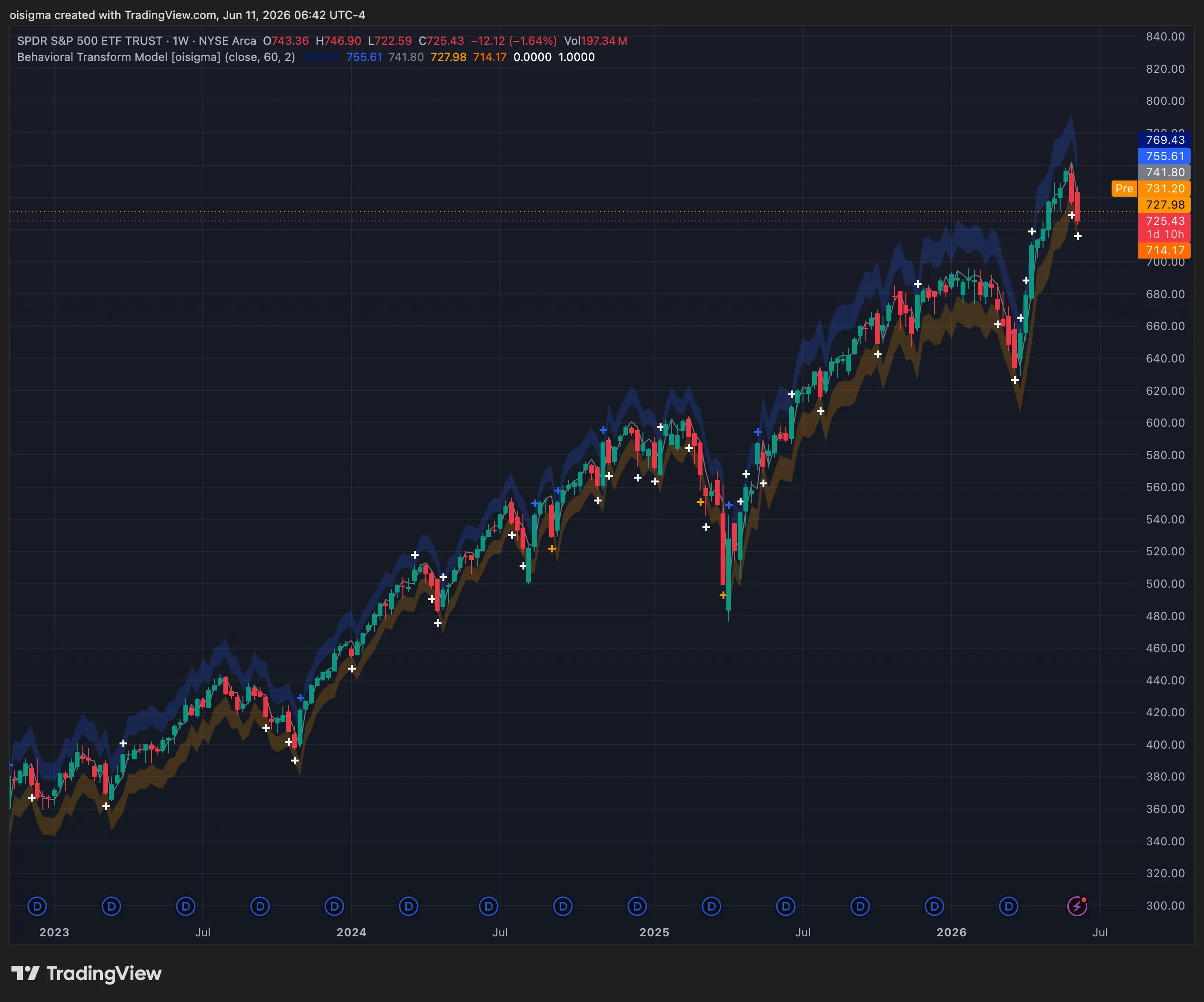
BTM on a chart — the expected range and abnormal-move band recalculating every bar, with markers where price stepped outside. Illustrative historical data; descriptive context, not a trading signal or a recommendation.
Figures are historical calibration measured in our working paper. Past behavior is not a guarantee of future results.
Read the proof →A 1% day is routine for Bitcoin and rare for a Treasury future.
Judged by eye, or by a fixed setting like 1.5× ATR measured in each instrument’s own units, the same move reads differently from chart to chart — and a move that’s unusual for a quiet market can look like nothing at all.
The usual workarounds don’t give one consistent answer: per-symbol settings that drift out of date, or support and resistance lines that every trader draws differently.
Price moves relative to how it’s recently been behaving — and most of the time it stays inside an expected range.
When it moves outside that range, that’s information: volatility, or the regime, may be changing.
So instead of asking “where should I draw the lines?” you ask a better question: is price behaving normally… or not?
The Behavioral Transform Model turns that idea into a picture on your chart, recalculated every bar:
Three things make it different from the bands traders already use:
No fitting, no tuning. BTM is a rolling measure of recent volatility, tested on the S&P 500 back to 1928. On calibration, it matched the volatility models institutional risk teams use (GARCH, RiskMetrics®).
Tested beyond where it was built. Similar containment showed up across equities and ETFs, currencies, gold, oil, Bitcoin and Ethereum, and across the cash, ETF and futures versions of the same market. It also held on a fresh, randomly chosen set of names the model was never tuned on.
Better calibrated than the band it resembles. Standard Bollinger Bands® imply about 95% containment at default (20, 2) settings but historically contained about 83% of next closes. A price-based band lags in a trend and counts that trend as “volatility.” Measuring in return space fixes both.
Not an ATR multiple. An ATR setting is measured in points, so one setting means different things on different symbols, and it isn’t built to a stated containment rate, so there’s nothing to check it against. BTM is built to a stated rate and checked against history.
Where it falls short. The outer band is slightly optimistic in the deep tails, and in the first days of the most extreme volatility onsets, containment fell to about 65%. Past behavior is not a guarantee of future results. It’s all in the working paper.
BTM gives you one thing: a calibrated range, recalculated every bar. That single input helps you reason about a few questions — as descriptive context, never as a strategy or a signal.
The marker answers as soon as price leaves the expected range. An expected range, not a claim that price reverses at the edges.
Same idea as Bollinger Bands®, measured in return space — where it calibrates.
Volatility shown as a range on the price chart, not a number in a sub-pane. Some traders compare it with what options are pricing. A reference point, not a forecast.
One setting across everything you follow, so a marker on one symbol means the same as a marker on another.
It does not predict price, generate buy/sell signals, or guarantee outcomes. Live markers can change until the candle closes. The working paper validates the range's calibration — not the profitability of any particular way you might use it. Options and other derivatives carry additional risk.
BTM came out of independent research into one question: can a simple volatility band say something true about where price usually trades? The answer, the method and the misses are all in a public working paper.
AlEssa, M. A. H. (2026). “How Well Does a Rolling-Volatility Band Calibrate? Evidence Across Asset Classes and Market Regimes.” oisigma.com LLC. Working paper, not peer-reviewed. Available on SSRN: https://ssrn.com/abstract=6970098
$15 / month — after a free 30-day trial.
Start with a 30-day free trial. No long-term commitment.
30-day free trial, then $15/month USD plus any applicable taxes — auto-renews until you cancel.
Finish what you started.
You're on the $15/mo plan.
Name and email, or sign up with Google. We email you a 6-digit code, so there's no password to set.
Add a payment method to start your 30-day free trial. The first charge is 30 days after signup, and you can cancel anytime before then.
Enter your TradingView public name. We grant access to your account by hand, usually within a few hours.
Your trial is active. Open Indicators → Invite-only scripts and add BTM. It works on any symbol and any standard candle or bar chart, including on TradingView’s free plan.
Live markers can. A marker appears as soon as price moves outside the expected range during a candle, and it’s removed if the candle closes back inside. Once a candle closes, its range and marker are fixed and never change.
No. BTM describes how price is behaving against its own recent range. We tested whether markers predict direction and found nothing, so we don’t claim they do.
A Bollinger band is built in price, so the same setting means different things on different symbols, and it historically contained less than it implies. BTM gives you one setting for every chart, marks the moves outside the range, and publishes how often the range held. Thirty days is enough to compare both on your own charts.
Any symbol on a standard candle or bar chart. Published figures are on daily bars. Heikin Ashi, Renko and Range charts aren’t supported.
Oisigma indicators are delivered through TradingView.
Non-standard chart types (Heikin Ashi, Renko, Range) are not supported.
Symbol, timeframe, source, and lookback period all affect the output.
It shows where price is relative to its recent range; it does not forecast price or provide buy/sell instructions.
Trading involves risk, including the possible loss of capital. Options and other derivatives carry additional risk.
Thirty days free, on your own charts.
30-day free trial, then $15/month USD plus any applicable taxes — auto-renews until you cancel. Cancel anytime. Requires a TradingView account.